Root Cause Analysis with AI in Production

Root cause analysis with AI is a new approach that enables companies to get to the bottom of problems in their production processes and eliminate them permanently. This can help to avoid unplanned downtime and reduce quality defects in manufactured products.
Root cause analysis is about understanding the underlying causal relationships that have led to problems. After all, problems can only be permanently eliminated by addressing their root causes. Treating the symptoms alone, on the other hand, only solves problems in the short term, and the same error will soon reoccur.
In the following, you will learn
- Why root cause analysis is becoming increasingly important for manufacturing companies.
- Why common methods are reaching their limits in today's practice.
- Why AI is needed to meet the new requirements.
Root cause analysis in production is gaining importance
The complexity of production facilities is increasing. The reason for this is the ever-growing demands on
- Favorable prices
- Highest quality
- Short delivery times
- High degree of product customization
Application experts are responsible for ensuring good production results. However, as production becomes more complex, problems in the manufacturing process are increasingly likely to occur. Cause analysis is a proven tool for reliably identifying and eliminating weak points.
However, classic methods such as 5 Whys, the fishbone model, or an analysis of the events leading up to a problem are now reaching their limits. They are based on the assumption that experts can deduce the causal chain for the error event. But what happens when production becomes so complex that even the most experienced specialists are no longer able to do so? Then crucial connections are overlooked or random events are classified as causes.
Cause analysis with AI offers new opportunities
Above a certain level of complexity, human intuition and experience alone are no longer sufficient. Digital tools from Industry 4.0 therefore supplement conventional methods of root cause analysis with data evaluations that draw on statistical procedures or artificial intelligence (AI) methods.
How exactly can AI contribute here? Manufacturing companies record large amounts of data, which, as things stand today, are rarely used to identify causes. AI can build on this data pool and independently identify anomalies that may have caused a problem. Of course, the assumptions of the application experts should always be checked at the same time.
The most important prerequisite for the effective use of AI, including for root cause analysis, is the preparation of data based on a solid AI data strategy. If you are still looking for suitable offers for the development of your AI data strategy, please feel free to contact us about our proven aiXbrain data audit.
How you can continuously improve processes with AI
The continuous improvement of problematic processes in production with AI can be explained well in four steps:
- Describe the
problems Clearly define the problems whose causes you want to better understand, and take the current state of knowledge into account. - Identify
possible causes Identify possible causes using a combination of common methods and data-based insights provided by AI. - Implement
corrective measures Use all insights to eliminate the root causes of the problems as thoroughly as possible. - Monitor and follow up
on the process Continuously check whether the analyzed problems are decreasing. Also monitor all influencing factors that have been identified in the analysis so far. If the same problems continue to occur, use the newly gained insights to start again at step 1 with an improved level of knowledge.
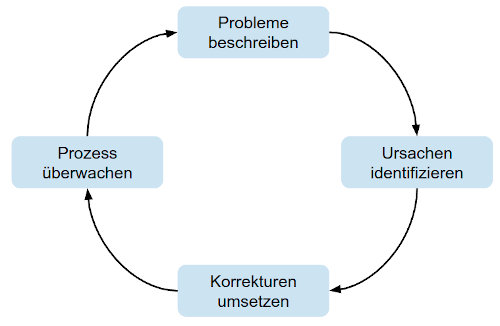
Fig. 1: Continuous improvement process based on root cause analysis
A key factor for the success of the improvement loop is close cooperation between application experts and AI. The application experts define the error events and make initial assumptions about their causes based on their experience. AI examines production data in a purely data-driven manner and either confirms the assumptions or derives new assumptions from the data. The new assumptions are then reviewed and evaluated by the experts. Through this interaction, new insights into reliable cause-and-effect relationships are uncovered and the level of knowledge is continuously expanded.
If you would like to learn more about the workflows involved in AI-based root cause analysis, we recommend the white paper AI-based Root Cause Analysis: Understanding and Optimizing Production Processes from Fraunhofer IAIS or our articles on How Can Humans and AI Work Together? and AI in Production: Does AI Owe You an Explanation?
Conclusion and outlook
In our opinion, manufacturing companies in Germany will be able to benefit greatly from AI-based root cause analysis in the coming years in order to maintain and expand their competitiveness. This could be to permanently eliminate problems in their own operational processes or to ensure the smooth use of their products by customers.
Our daily work at aiXbrain revolves around making these possibilities quickly and easily accessible, for example with aiXbrain Dataray, an AI software solution for the rapid diagnosis of problems in process flows. In addition, we are actively involved in the GeMeKI project, which focuses on the human-centered design of such AI-based assistance tools.