Focus on technical cleanliness: SiPaFeB consortium at EAS

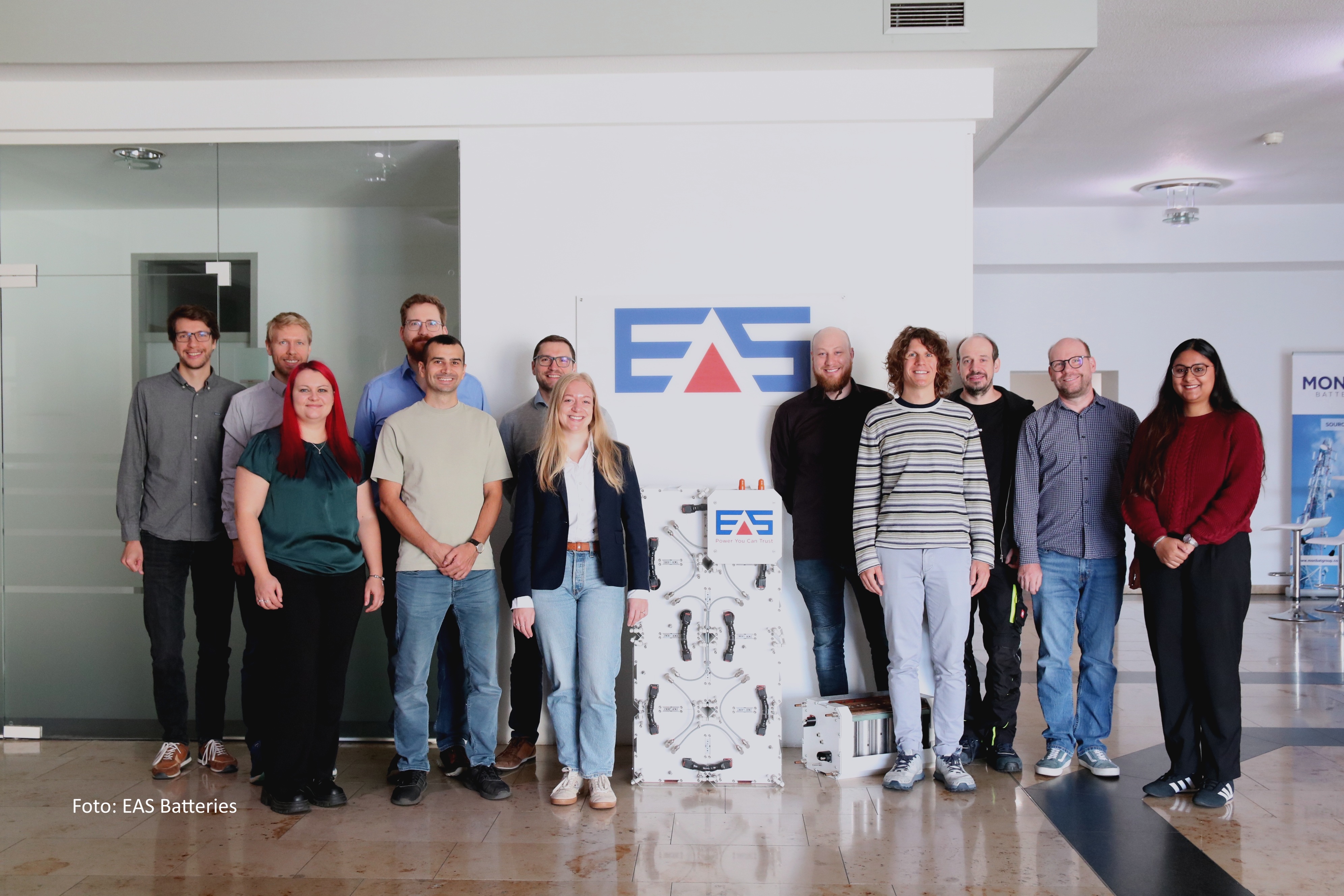
Hairnet on, lab coat on, shoe covers over the shoes: Only then were we ready to enter the cleanroom for cell production.
On September 30, 2026, the consortium of the research project "SiPaFeb - Ensuring particle-free production of battery cells" met at EAS in Nordhausen. Representing aiXbrain were Dr. Simon Görtzen and Holger Pigerl.
The focus was on technical cleanliness in battery cell production—specifically, how to keep particles out of the process.
Status update: Processes, roles, and particle traps
The meeting kicked off with the status of the work packages.
We presented the results of our user analysis: the structured mapping of the production process, the relevant roles, and a comparison of the workflows and technical processes at Fraunhofer Research Institution for Battery Cell Production FFB and EAS Batteries GmbH. This is the foundation for everything that follows, because an AI tool will only be used if it fits the people and the decision-making processes on the production floor.
CleanControlling reported on their cleanliness audits. For this, the team had placed and evaluated particle traps throughout the production lines at FFB and EAS. Together with our analysis, this reveals two things: how production is organized and where particles actually accumulate.
Site visit: Technical cleanliness you can wear
After that, we moved on to the cell production, partly in the cleanroom.
By the time you put on the protective clothing, it becomes clear what the project is all about: every particle introduced into the process by people, equipment, or materials can end up inside a cell. In the worst-case scenario, a single conductive particle between the electrodes can cause an internal short circuit, and there is no way to see that from the outside of the cell.
Special attention was therefore paid to the process steps that generate the highest number of particles.
Sensors for assembly
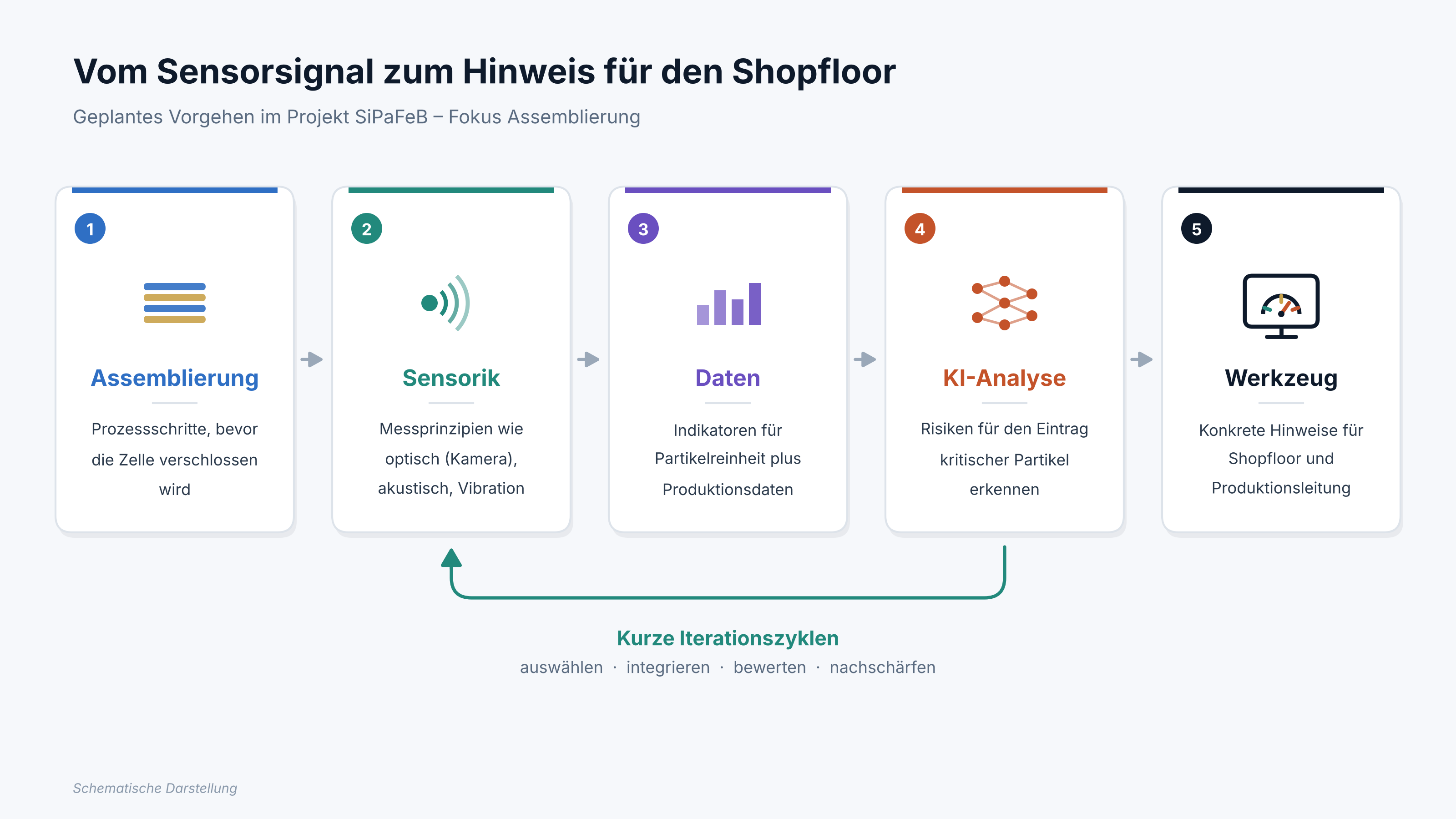
In the workshop session , all partners worked together to determine how critical process steps could be equipped with sensors and how indicators for particle cleanliness could be digitally recorded.
The focus is on assembly, where electrodes and separators are joined to form the cell. This is the point of no return for what stays inside the cell: any particle that gets in now cannot be removed. Once the cell is sealed, its interior is no longer visible from the outside. Additional production data is also being incorporated.
For the assembly process, concrete approaches based on various physical measurement principles were already on the table. The consortium agreed to proceed in short cycles: select sensors, integrate, evaluate, and refine. This allows us to see early on which signals actually provide meaningful information about particle cleanliness.
The partners considered the software architecture, including its protocols and interfaces, from the very beginning to ensure that every new sensor does not result in an isolated, proprietary solution.
A proof of concept we have already built at aiXbrain demonstrates how AI can be integrated into this architecture: an AI agent that accesses the m2v API from Eurogard via an MCP server.
MCP (Model Context Protocol) is an open standard that allows AI agents to access data sources and tools. Unfortunately, we ran out of time for the demo in Nordhausen, but we will catch up on it as soon as possible.
The goal: Transparency in particle contamination
Ultimately, what matters is what the project reveals about the risk of critical particles entering cells.
The aim is for an AI analysis of the recorded data to provide these insights. This will result in a tool for shop floor personnel and production management that makes the "particle contamination" black box transparent and provides concrete guidance to ensure the quality and safety of the cells.
For example, it could indicate at which process step the risk is currently increasing, before a problem becomes apparent in the finished cell.
Conclusion: The foundation is set, now it's time to measure
With user analysis and cleanliness audits, the consortium brought a solid foundation to Nordhausen.
On-site, the partners examined the production process together and designed the sensor concept for assembly directly on the actual production line.
A big thank you goes to EAS for hosting us and opening their cell production and cleanroom to the consortium, and to all project partners for their constructive collaboration.
We are confident that the data from the assembly process will show, step by step, where critical particles enter the cell and how this can be prevented. In this way, the black box will gradually become a process that can be seen and controlled.
Funding information:
Funding agency: BMFTR (»Clusters Go Industry«)
Grant number: 03XPB024E
Duration: 01/01/2026 - 12/31/2028