The 5 Most Important Questions for Digitizing Products with AI


In their digitalization strategy, many companies have already recognized that they can enhance their products with the help of artificial intelligence. This usually means tapping into data on product use and evaluating it intelligently in order to create new, valuable offers for customers. In this article, we have compiled the five most important questions that are crucial for such an AI upgrade.
1. Which use case should be served?
The first question is which use case will create value for your customers. What additional needs do your customers have when using your products? Are there already third-party solutions for this? Could you offer a better solution with a data-driven add-on service?
When searching for a suitable use case, it is advisable to analyze how users interact with your product on a daily basis. For example, can interaction with AI be simplified or even automated? What additional information could make users' lives easier? Or could you perhaps improve your own services related to your product by receiving early notifications and predictions about runtime operations?
2. Which business model should be used to generate revenue?
In direct connection with the use case, the question arises as to how money can be earned with it in concrete terms. The type of service and pricing model play the main roles here. The type of service and pricing model must match the application behavior of the users. Possible types of service include software-as-a-service (SaaS), a customized service package, or hardware rental instead of sales. In addition to the classic sale of licenses, common pricing models now increasingly include flexible subscription models, pay-per-use, pay-per-part, or freemium offers. You can find more details on these and other possible business models in this article.
3. Which AI model is appropriate?
Once you are convinced of your project from a business perspective, you can start thinking about the right AI model. There is a wide range of possible AI models to choose from, and they are always application- or use case-specific. However, you can pre-filter them quite well by specifying specific requirements for the required AI functionality—such as pattern recognition, classification, or the detection of chains of effects—as well as the necessary explainability of the AI results.
The explainability of results is increasingly proving to be a fundamental prerequisite for acceptance by human users, especially in the context of human-centered AI. In addition to the pure result, explainable AI also provides insight into the underlying relationships that led to this result. This can be, for example, a prioritization of influencing factors or an evaluation of the underlying database. Not all AI models are suitable for this.
4. What data is required?
AI cannot learn without suitable data and, in the worst case, will never progress beyond the beginner stage. "Suitable" here means that the data contains as many meaningful examples as possible that are relevant to the use cases under consideration (data breadth). In addition, the data must of course also contain all parameters that play a decisive role (data depth). An initial AI data quick check can help to quickly assess the suitability of the available data for the intended use case, identify any gaps, and obtain useful suggestions for additions.
5: What digital infrastructure is needed?
Additional digital infrastructure, such as special sensors, may be required, and not just to close any data gaps. The digital infrastructure connects data, AI, and business, usage, and billing models. It consists of interlocking hardware and software components, such as sensors for data collection, fast processing of large amounts of data on an edge gateway, and data storage and processing in the cloud. In particular, the digital infrastructure must be designed in such a way that rapid rollout, updates, and scaling for many users are possible efficiently. Last but not least, you should also consider the necessary technology stack for your customers to interact with the newly created AI product, whether in software or with physical controls.
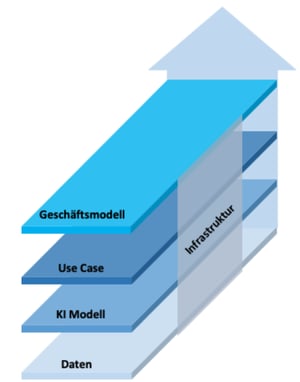
The 5 cornerstones of product digitalization with AI
Use case, business model, AI model, data, digital infrastructure—these are the 5 cornerstones of product digitalization with AI. It is important to start with the use case and business model before getting into discussions about technology and implementation. You should also keep in mind that the potential of AI depends heavily on the usable digital infrastructure. In short, AI power and digital infrastructure go hand in hand.