Wie können Mensch und KI zusammenarbeiten?

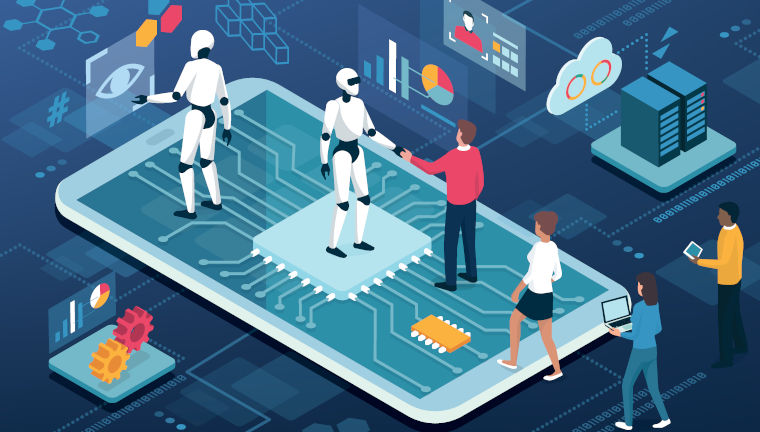
Deploying fully automated AI in production is only possible in exceptional cases. Often, it is much more sensible for humans and AI to complement each other through collaboration. This makes human-centered AI applications particularly compelling.
From the study "Human-Centered AI Applications in Production - Practical Experience and Implementation Guidelines for Industrial Deployment" published in March 2021 by the KI-Fortschrittszentrum in the "Learning Systems" series, we have compiled the key points for implementing human-centered AI applications in industrial production processes.
What Makes Human-Centered AI Different?
Human-centered AI fulfills work tasks while considering economic viability without losing sight of the capabilities and needs of the people in its environment. The underlying assumption is that organizations can only realize the full potential benefits of AI if they include humans as a central element in AI implementation.
What does it mean to "include humans in the thinking"? It means creating working conditions that increase job satisfaction and thus employee performance. In relation to AI implementation, the study identifies four essential design aspects that contribute to this:
- Ensure Human Protection
This includes data protection, ethical principles, and questions about responsibility and liability. - Establish Trustworthiness
Humans must be able to understand how the AI reaches its assessment in order to derive effective and safe decisions. Additionally, the system must be user-friendly, meaning it enables effective, efficient, and satisfying goal achievement. - Create Symbiotic Functional Division Between Humans and AI
Humans can override the AI in the work process and thus retain control. AI should support the work process while not overly restricting human autonomy. - Promote Human Capabilities
The scope for human action must be preserved or even expanded to enable learning experiences and maintain motivation.
In the short term, the human-centered design approach requires more effort than a purely technical one. However, AI should always be designed with a long-term perspective. Even the best AI can only contribute to success if users accept it, deploy it, and continuously help improve it. In the medium term, manufacturing companies benefit when their employees are open to AI initiatives and actively participate in shaping them.
How Can Human-Centered AI Be Implemented Gradually?
For manufacturing companies, the study provides an action guide that enables human-centered AI to be developed and implemented step by step. The 7 phases proposed in the study can be summarized into 4 steps:
Step 1: Preparation
In the first step (phases 1&2 of the study), the focus is primarily on preparing the workforce for the long-term introduction of AI in the organization. This should create a positive attitude toward AI among the workforce and foster dialogue across departments. To enable meaningful dialogue, it makes sense to provide employees with solid foundational AI knowledge.
Step 2: Planning
Once the dialogue has progressed sufficiently, it should be directed toward concrete goals through workshops to identify and detail AI use cases (phases 3&4 of the study). Here, the human-centered design approach stands out by including, alongside operational and technical metrics, human-oriented criteria such as usability, user acceptance, and ethical, legal and social compatibility as target measures or constraints.
Step 3: Implementation
In the implementation step (phases 5&6 of the study), an AI or integrated AI system is developed and evaluated against the target criteria and constraints. The human-centered approach places special emphasis on user interfaces and thus user interaction. In the evaluation, all specified criteria must be met. This can well result in a functionally viable AI with promising results being rejected if users are unwilling to deploy it because operation is cumbersome or they perceive their working conditions as compromised by its use.
Step 4: Deployment and Scaling
Even during deployment, operation, and scaling of a positively evaluated AI system (phase 7 of the study), active engagement of human users remains the essential factor. Employee expectations of the AI must be met and sustained motivation for collaboration must exist. Otherwise, sustainable human-AI collaboration cannot occur. The guide recommends regular exchange here to allow the AI to be adjusted as needed.
Conclusion
Human-centered AI design is still a relatively new approach. Fundamentally, it is about incorporating as many perspectives as possible. This enables AI solutions that sustainably increase productivity and integrate seamlessly into the human working day.